You Can't Predict a Hero by Joseph J. Grano
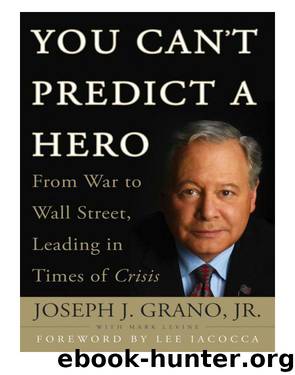
Author:Joseph J. Grano [Grano, Joseph J.]
Language: eng
Format: epub
Publisher: Wiley
Published: 2010-05-10T17:00:00+00:00
This Perfect Ten was our strategic response to the risks and opportunities uncovered during our environmental assessment of the firm and the industry as a whole. We created both a five- and a three-year pro forma for each initiative: the five-year model to support and justify the strategic plan and the three-year model to support the underlying business plan. We consolidated the pro formas for the ten initiatives so the team could see firsthand the power of a coordinated plan that could move PaineWebber from a losing enterprise to a winner.
By sharing with the total management team our environmental assessment of PaineWebber and the industry as a whole, we established a baseline for what I called “truth and consequences”: every member of the management team learned the truth and became acutely aware of the consequences if we didn’t move to ameliorate the situation.
We exceeded my private goal of earning $1 in the first year by $12,999,999. Our $13 million in earnings, coming a year after a loss of $96 million, represented a turnaround of approximately $109 million in one year. We subsequently sustained our momentum by moving from last to first in productivity per financial advisor, moving from last to first in assets per financial advisor, and moving from last to first in attracting financial advisors from competitors. In 2000, when PaineWebber merged with UBS, the retail group was earning $600 million.
Due in large part to the massive turnaround in consumer markets, I was promoted in 1994 to president of the entire firm. This position added the responsibilities for investment banking, equity and fixed income sales and trading, research, and asset management. Collectively in that year, these capital market entities were losing approximately $250 million.
The negative influences peppered throughout these organizations were the result of a siloed, hot-dot-centric culture reinforced by several prima donnas within each silo. A piece of business, a hot trader, a high-profile investment banker, or an institutionally ranked researched analyst dictated the firm’s resource allocations and dominated the bonus pools. There was no cohesive strategy. It was just “follow the hot dot” and respond to any and all demands from one of the prima donnas.
In my opinion, it was right around this time (mid-1990s) when Wall Street began to lose its perspective relative to pay practices. Leading bankers and research analysts, who were earning $1 million to $3 million a year, were receiving offers from competitors to leave for annual pay packages as high as $15 million. These large bulge bracket Wall Street firms abandoned good management pay practices and adopted a “buy market share at any price” model. No consideration was given to the impact on longer-term costs or the natural escalation of compensation at every level of the organization, as all ships rise with the tide.
After my sixty-day review of the people and the businesses, I concluded that our first priority was to stop the bleeding and ensure that no business activity could result in a loss that would exacerbate the situation. I replaced
Download
This site does not store any files on its server. We only index and link to content provided by other sites. Please contact the content providers to delete copyright contents if any and email us, we'll remove relevant links or contents immediately.
Hit Refresh by Satya Nadella(9140)
When Breath Becomes Air by Paul Kalanithi(8449)
The Girl Without a Voice by Casey Watson(7890)
A Court of Wings and Ruin by Sarah J. Maas(7853)
Do No Harm Stories of Life, Death and Brain Surgery by Henry Marsh(6944)
Shoe Dog by Phil Knight(5271)
The Rules Do Not Apply by Ariel Levy(4972)
A Higher Loyalty: Truth, Lies, and Leadership by James Comey(4965)
Hunger by Roxane Gay(4929)
Tuesdays with Morrie by Mitch Albom(4788)
Everything Happens for a Reason by Kate Bowler(4745)
The Immortal Life of Henrietta Lacks by Rebecca Skloot(4592)
Millionaire: The Philanderer, Gambler, and Duelist Who Invented Modern Finance by Janet Gleeson(4481)
How to Change Your Mind by Michael Pollan(4358)
All Creatures Great and Small by James Herriot(4326)
The Money Culture by Michael Lewis(4211)
Man and His Symbols by Carl Gustav Jung(4138)
Elon Musk by Ashlee Vance(4129)
Tokyo Vice: An American Reporter on the Police Beat in Japan by Jake Adelstein(3997)
